

Oleh: Mulya Sarmono, SH., MH
Korelasi Korupsi dan Pelaksanaan Pilkada
Salah satu “momok” yang merusak pelaksanaan Pemilihan Kepala Daerah dan kembali menjadi ancaman pada pelaksanaannya di tahun 2024 adalah korupsi politik. Korupsi politik sendiri menurut Hodess adalah penyalahgunaan kekuasaan oleh pemimpin politik dengan mengakumulasi kekuasaan dan kekayaan serta untuk keuntungan pribadi. Korupsi politik tidak hanya dalam bentuk pertukaran uang, tetapi juga berupa memperdagangkan pengaruh atau memberikan fasilitas yang meracuni politik dan mengancam demokrasi.[1]
Lebih lanjut, Artidjo Alkostar menyatakan bahwa korupsi politik yaitu suatu tindakan yang dilakukan oleh elit politik atau pejabat pemerintahan Negara yang memiliki dampak terhadap keadaan politik dan ekonomi Negara. Perbuatan ini biasanya dilakukan oleh orang-orang dan atau pihak-pihak yang memiliki jabatan atau posisi politik. Korupsi politik ini bisa dilakukan oleh presiden, kepala pemerintah, para menteri suatu kabinet yang pada dasarnya memiliki jabatan politis, anggota parlemen, dapat dikualifikasikan sebagai korupsi politik, karena perbuatan itu dilakukan dengan mempergunakan fasilitas atau kemudahan politis yang dipunyai oleh pelaku. Fasilitas yang disalahgunakan tersebut pada dasarnya merupakan amanat atau kepercayaan yang diberikan oleh rakyat.[2]
Penjelasan tersebut di atas, menunjukkan bahwa korupsi politik bukan melulu soal uang, tetapi juga perihal penggunaan kekuasaan, fasilitas dan kemudahan yang diperoleh karena jabatan, yang ditujukan untuk kepentingan politik diri atau kelompoknya. Meski demikian, korupsi politik dalam lingkup politik praktis, lebih mengarah pada penggunaan uang negara untuk kepentingan pencalonan. Nassmacher menyatakan, uang mempengaruhi politik karena uang merupakan sumber daya utama bagi politik yang ingin berkuasa. Terutama karena uang dapat dikonversi dengan mudah ke berbagai bentuk sumber daya lainnya. Uang dapat dipergunakan untuk membeli barang seperti peralatan kampanye, iklan dan sebagainya. Uang juga diperlukan untuk membeli jasa dan keterampilan, terutama jasa dan konsultan politik.[3]
Faktor lainnya yaitu pembiayaan partai politik yang seringkali berasal dari uang korupsi. Menurut Theodore M. Smith, partai-partai politik, terutama partai politik yang baru, membutuhkan pembiayaan yang hanya dapat dipenuhi secara tidak teratur di sebagian besar negara berpenghasilan rendah. Investasi organisasi dan pembelian dukungan mereka memerlukan uang banyak sekali, dan sering satu-satunya cara yang tersedia untuk memperoleh modal kerja demikian itu ialah dengan menyedotnya dari negara.[4]
Analisis di atas memperjelas mengenai proses Pilkada yang dilakukan dengan cara curang, berkorelasi dengan korupsi politik di suatu daerah. Data dari Indonesia Corruption Watch (ICW) misalnya mencatat bahwa terdapat korelasi antara korupsi dan pelaksanaan Pilkada di daerah. Dalam catatan ICW pada tahun 2018, terdapat 11 kasus korupsi yang berhubungan dengan kontestasi Pilkada.[5]
Lebih lanjut, ICW juga menyatakan bahwa terdapat 10 permasalahan yang membayangi pelaksanaan Pilkada yang pada pokoknya, yaitu:
- Jual beli pencalonan (candidacy buying) antara kandidat dan partai politik.
- Munculnya nama bermasalah (mantan narapidana atau tersangka korupsi) dan calon dengan dinasti.
- Munculnya calon tunggal.
- Kampanye berbiaya tinggi.
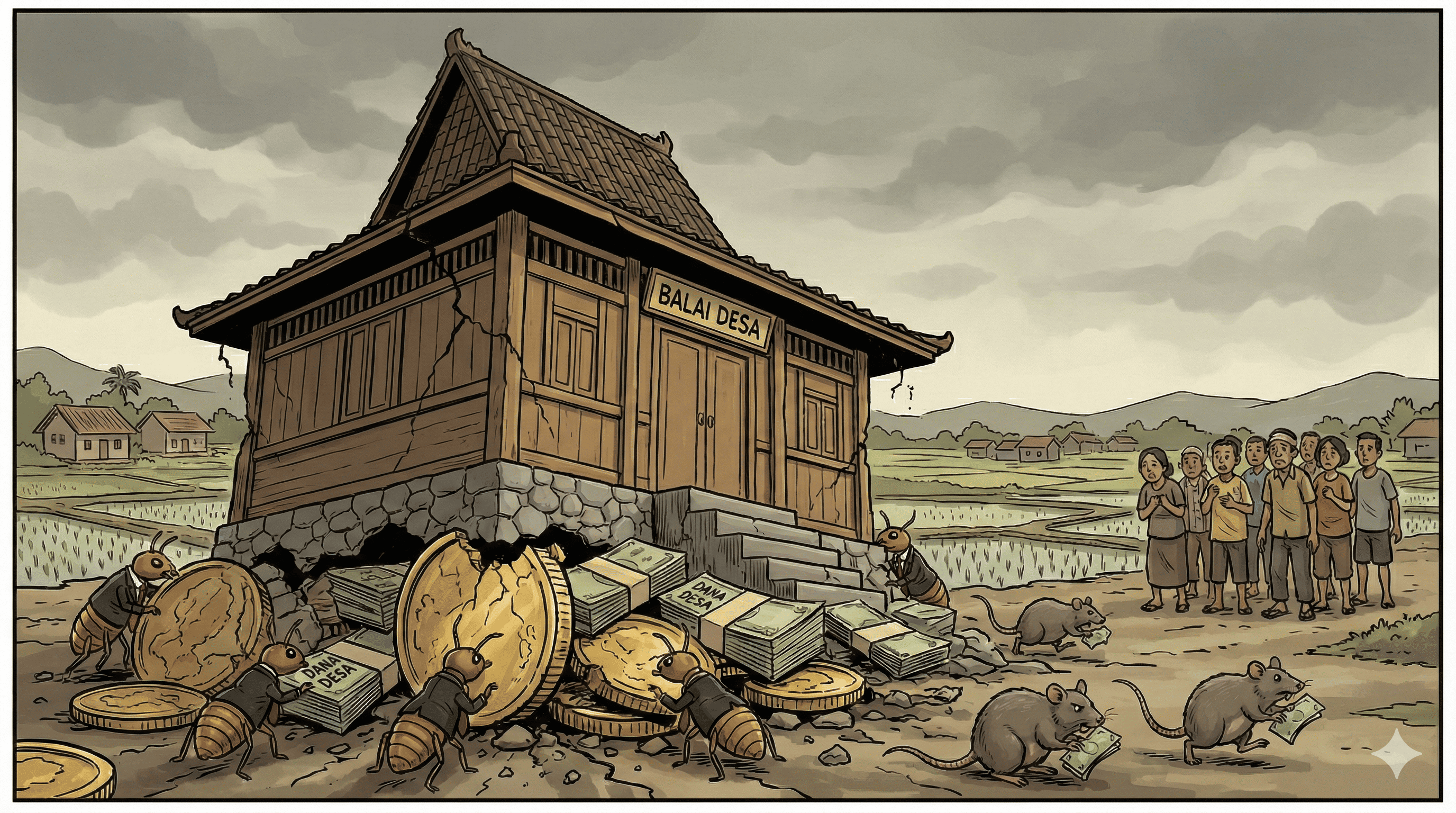
- Pengumpulan modal ilegal (jual beli izin usaha, jual beli jabatan, suap proyek, dll) dan politisasi program pemerintah (dana hibah, bantuan sosial, dana desa, dan anggaran rawan lainnya) untuk kampanye.
- Politisasi birokrasi dan pejabat negara, mulai dari birokrat, guru, hingga institusi TNI/ Polri.
- Politik uang (jual beli suara pemilih).
- Manipulasi laporan dana kampanye.
- Suap kepada penyelenggara pemilu.
- Korupsi untuk pengumpulan modal, jual beli perizinan, jual beli jabatan, hingga [6]
Potensi Korupsi Politik pada Badan Usaha Milik Daerah
Pada tahun 2022, tercatat Perusahaan BUMD di Indonesia berjumlah 1.133 perusahaan dengan rincian, 1.084 perusahaan berstatus aktif, sementara 49 perusahaan lainnya berstatus tutup sementara.[7] Aset dari perusahaan tersebut pada tahun tahun yang sama tercatat senilai Rp. 894.532.735 dengan laba bersih sebanyak Rp. 12.483.653. Lapangan usahanya cukup beragam, mulai dari pertanian, kehutanan dan perikanan, pertambangan, konstruksi, transportasi dan pergudangan, informasi dan komunikasi, aktivitas keuangan dan asuransi, real estate, jasa kesehatan dan kegiatan sosial serta berbagai usaha lainnya.[8] BUMD sendiri secara umum memiliki dua jenis sebagaimana dalam Pasal 4 Ayat (3) PP No. 54 Tahun 2017 Tentang Badan Usaha Milik Daerah, yaitu Perusahaan Umum Daerah dan Perusahaan Perseroan Daerah. Beragamnya jenis usaha dengan aset dan laba bersih yang cukup besar, menjadikan BUMD sebagai perusahaan daerah yang akan mudah menjadi lirikan bagi para koruptor di Indonesia.
Pada konteks kasus korupsi di Indonesia, Tindak Pidana Korupsi berdasarkan Instansi yang dirilis oleh Komisi Pemberantasan Korupsi menyebutkan bahwa Instansi yang banyak kasus korupsi, salah satunya adalah Badan usaha Milik Negara/Badan Usaha Milik Daerah (BUMN/BUMD). Pada tahun 2021, terdapat 8 kasus, tahun 2022 terdapat 12 kasus dan tahun 2023 terdapat 34 kasus korupsi.[9] Setiap tahun dan tentunya semakin mendekati pesta demokrasi, baik itu Pemilu maupun Pilkada, pada instansi tersebut terdapat peningkatan kasus yang terjadi. Lebih lanjut, KPK mencatat dari penanganan Tindak Pidana Korupsi periode 2004 sampai Maret 2021, terdapat 93 dari 1140 tersangka atau 8,12% merupakan jajaran BUMD.[10]
Banyaknya jumlah BUMD dengan aset dan laba yang cukup besar tersebut, disertai dengan data kasus korupsi pada instansi tersebut di atas, menjadi catatan yang menimbulkan kekhawatiran bahwa kedepannya, kasus serupa akan kembali terjadi. Terlebih, saat ini, terdapat 545 daerah di Indonesia yang akan melaksanakan Pilkada tahun 2024, dengan rincian; 37 provinsi (Pemilihan Calon Gubernur dan Wakil Gubernur), 508 kabupaten/kota (Pemilihan Calon Bupati dan Wakil Bupati serta Calon Walikota dan Wakil Walikota).[11] Artinya, berdasarkan beberapa indikator itu, potensi korupsi politik pada Pilkada 2024 akan semakin besar, serta BUMD di berbagai daerah akan berpotensi menjadi lumbung bagi para koruptor menjalankan aksinya, demi memenangkan kontestasi.
Upaya Mencegah dan Memberantas Korupsi Politik
Terdapat tiga hal penting untuk dilakukan untuk mencegah dan memberantas korupsi politik pada proses Pilkada saat ini. Pertama, adanya transparansi anggaran, baik itu dalam pengelolaan BUMD di berbagai daerah maupun transparansi dana partai politik dan kandidat yang akan maju dalam pemilihan di daerah. Keterbukaan anggaran tersebut akan menjadi penting dalam hal pencegahan sejak dini korupsi politik. Kedua, yaitu penegakan hukum yang benar-benar dilaksanakan secara profesional. Penegakan hukum yang baik menjadi faktor utama dalam pemberantasan korupsi.
Poin terakhir yang tidak kalah penting yaitu partisipasi masyarakat yang akan berperan dalam mencegah dan memberantas korupsi politik di berbagai daerah. Peran masyarakat tersebut menjadi salah satu amanah peraturan perundang-undangan, misalnya dalam PP No. 43 Tahun 2018 tentang Tata Cara Pelaksanaan Peran Serta Masyarakat dan Pemberian Penghargaan dalam Pencegahan dan Pemberantasan Tindak Pidana Korupsi. Peran masyarakat untuk menumbuhkan budaya anti korupsi, politik yang sehat dan bermartabat serta upaya melaporkan adanya dugaan korupsi dan pelanggaran pelaksanaan Pilkada menjadi faktor yang tidak kalah penting agar korupsi politik dapat dikikis sedikit demi sedikit. Artinya, dibutuhkan kolaborasi dengan berbagai elemen untuk bisa mencegah agar korupsi politik pada Pilkada 2024 ini, terkhusus pada lingkup perusahaan daerah, bisa diatasi bersama.
Penulis adalah Praktisi Hukum dan Pegiat Demokrasi yang saat ini berdomisili di Jakarta. Pria kelahiran Majene, Sulawesi Barat ini memperoleh gelar sarjananya pada Fakultas Hukum Universitas Muslim Indonesia Makassar tahun 2015 serta gelar magisternya di Fakultas Hukum Universitas Trisakti Jakarta tahun 2023. Pada tahun 2019, Ia pernah mengikuti pelatihan internasional mengenai Bisnis dan Hak Asasi Manusia di Chiang Mai, Thailand. Sebelumnya, Ia pernah menjadi peneliti di Anti Corruption Committee (ACC) Sulawesi serta menjadi Advokat Publik di Lembaga Bantuan Hukum (LBH) Pers Jakarta. Saat ini, Ia fokus menjalankan profesinya sebagai advokat dan peneliti dan menulis di jurnal, baik nasional maupun internasional serta di berbagai media massa di Indonesia.
[1] Robin Hodess, Introduction. Dalam Transparency International. 2004. Global Corruption Report 2004. Special Focus: Political Corruption. (London, Sterling VA: Pluto Press & Transparency International, London, Sterling VA, 2004), sebagaimana dikutip dalam Danang Widoyoko, Oligarki dan Korupsi Politik Indonesia (Strategi Memutus Oligarki dan Reproduksi Korupsi Politik), (Malang: Setara Press, 2013), 13.
[2]Artidjo Alkostar, Korupsi Politik di Negara Modern, (Yogyakarta: FH UII Press, 2008), 19.
[3] Nessmacher, Karl Heinz (ed), Foundations for Democracy. Approaches to Comparative Political Finance. (Baden-Baden: Nomos Verlagsgesellschaft, 2001), 9 sebagaimana dikutip pada Danang Widoyoko,Op. cit, 11
[4] Theodore M. Smith, Korupsi, Tradisi dan Perubahan di Indonesia, dalam Mochtar Lubis dan James C. Scott (Penyunting), Korupsi Politik, (Jakarta: Yayasan Obor Indonesia, 1990), 63.
[5] Mimi Kartika, ICW: Ada Relevansi Antara Korupsi dan Pilkada, (republika.co.id), 15 Oktober 2020, diakses 03 Juli 2024. https://republika.co.id/berita/qi8how428/icw-ada-relevansi-antara-korupsi-dan-pilkada.
[6] ICW, Outlook Korupsi Politik 2018: Ancaman Korupsi di Balik Pemilu 2018 dan 2019, (Jakarta: ICW, 2018), 2. https://antikorupsi.org/sites/default/files/dokumen/outlook_korupsi_politik_2018_110118.pdf.
[7] Badan Pusat Statistik, Statistik Keuangan Badan Usaha Milik Negara dan Badan Usaha Milik Daerah 2022, Volume 15, 2023, (Jakarta: BPS, 2023), 47.
[8] Ibid., 50.
[9] KPK, Statistik TPK Berdasarkan Instansi, (kpk.go.id), 22 Januari 2024, diakses 03 Juli 2024. https://www.kpk.go.id/id/statistik/penindakan/tpk-berdasarkan-instansi
[10] Mochamad Januar Rizki, Marak Kasus Korupsi BUMD, Ini Langkah Antisipasi yang Harus Dilakukan, (hukumonline.com), 9 September 2021, diakses 03 Juli 2024. https://www.hukumonline.com/berita/a/marak-kasus-korupsi-bumd--ini-langkah-antisipasi-yang-harus-dilakukan-lt631a46d41ed05/?page=1.
[11] Widhia Arum Wibawana, Berapa Daerah yang Ikut Pilkada Serentak 2024? Simak Daftarnya, (news.detik.com), 25 April 2024, diakses 03 Juli 2024. https://news.detik.com/pemilu/d-7310656/berapa-daerah-yang-ikut-pilkada-serentak-2024-simak-daftarnya#:~:text=Menurut%20laporan%20data%20dari%20KPU,pada%20Rabu%2C%2027%20November%202024.






Komentar Untuk Berita Ini (0)
Posting komentar