
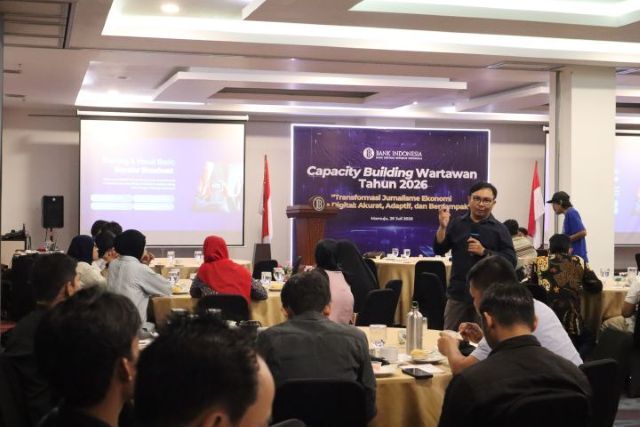
MAMUJU — The mass media landscape is experiencing radical disruption. The drastic decline in search traffic due to artificial intelligence (AI) features in search engines is forcing journalists to evolve. The future of journalism now hinges on journalists' ability to directly penetrate social media as adaptive content creators, without abandoning the principle of strict verification.
This issue was strongly highlighted at the 2026 Journalist Capacity Building event held by Bank Indonesia in Mamuju, West Sulawesi, on Thursday (July 29, 2026). Media expert and senior television journalist Tri Suharman, S.E., M.I.Kom, served as the keynote speaker, highlighting the urgency of adapting economic journalism in the digital era.
The Threat of Disruption and Content Creator Journalists
In his presentation, Tri revealed a new reality: global organic traffic from search engines like Google has plummeted by 33 percent. This decline is due to the AI Overview feature, which automatically summarizes information, thus changing audience behavior, which no longer actively browses news portals.
"If our news isn't distributed aggressively through social media feeds, no matter how great our coverage, it will die without readers or viewers," explained Tri Suharman.
Facing this trend, he emphasized the importance of journalists transforming into "Content Creator Journalists." Currently, 76 percent of global media publishers have transformed their staff into digital content creators focused on social media distribution. Information delivery strategies are also shifting, from formal text formats to prioritizing short videos on platforms like TikTok, YouTube, and Instagram, which rely on visual engagement.
Mastering the Attention Economy on Social Media
Penetrating social media requires journalists to master the Attention Economy. Tri explained that the average human attention span has now shrunk drastically to only about eight seconds.
A strong hook strategy includes unexpected visual appeal, unique, trending audio, and opening text that immediately piques the audience's curiosity. This practice is embodied in Digital Storytelling techniques—from the beginning (hook) to grab attention, the middle (core) to maintain a balance of news value, to the end (action) that builds a meaningful connection with the audience.
Smartly Leveraging AI and Upholding the Golden Rule
Furthermore, Tri encouraged journalists to be agile in using a variety of artificial intelligence (AI) software to support content production. Tools like ChatGPT, Gemini, Claude, transcription assistants like Riverside, and modern video generators can speed up editorial work.
However, this technological convenience carries a strong warning. Tri urged journalists to remain vigilant against the potential for AI hallucinations—misinformation generated by machines. This vigilance must be balanced with strict verification discipline, as the Golden Rule of digital journalism.
"Hoaxes spread in seconds—verification is an absolute must. Fact-checking in the editorial office is the lifeblood of credible media," Tri emphasized. The Data-Driven Journalism approach is also considered highly effective in strengthening the watchdog function and restoring eroding public trust.
Through this training session with approximately 70 cyber journalists in West Sulawesi, Bank Indonesia hopes that regional journalists can continue to improve their capacity.
Healthy journalism cannot be defeated by technological disruption or economic fluctuations. With consistent resilience and adaptation, the press will continue to grow, report the truth, educate the nation, and stand strong as a pillar of democracy.
(Erisusanto)






Comments For This News (0)
Post a comment